
Why you should avoid a complex oil and gas deliverability test
Some wells are tested with deliverability tests, instead of PBUs, to assess productivity. This could result in a misleading well and reservoir performance, in particular with low to mid permeability reservoirs. As a matter of fact, there is no other alternative to PBU/PFO tests so as to get KH and skin under transient behaviour.
Complex deliverability tests are passed their due date, in particular with well testing. Experts in several majors agree: fancy deliverability tests are no longer run in well test operations, and for good reasons.
Different types of oil and gas deliverability tests
Some service companies still recommend an oil and gas deliverability test. This could include:
-
The flow-after-flow test:
This is an increasing or decreasing three step rate test.
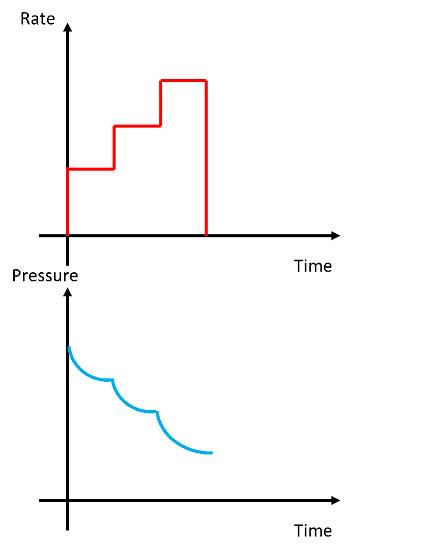
This test assumes that pseudo-steady state is reached during each flow period so that the transient behaviour during one flow period is not propagated to the next flow period. Unless the permeability in the reservoir is high (100 mD plus), you won’t expect to reach pseudo-steady state after flowing a well for a couple of hours. As a result, for low to mid permeability reservoirs, this test cannot be performed in a reasonable time frame.
-
Isochronal test:
The operator flows the well at different rates for the same duration ∆T, each separated by a PBU test. Each shut-in needs to be long enough to reach the stabilized average reservoir pressure.
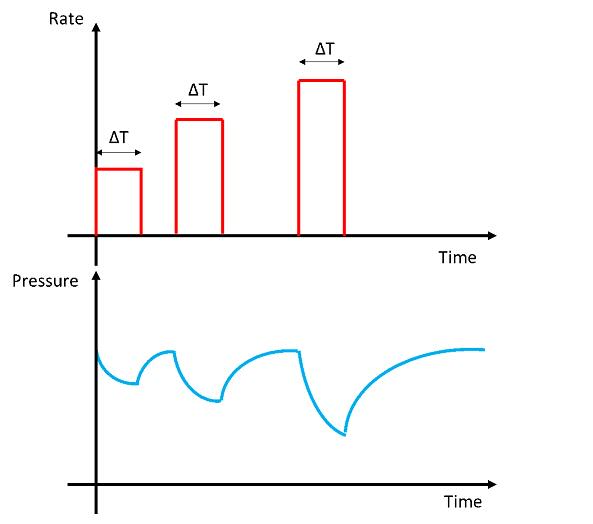
The flowing periods are of same duration ∆T, which could be of 3 hours for example. As the rate increases, the consecutive shut-in needs to be longer so as to reach the stabilized initial pressure or average reservoir pressure.
In practice for low to mid permeability reservoirs, this test is also not feasible since the shut-in duration would be too long to reach stabilized reservoir pressure. If too short, the results for this deliverability test on these types of reservoirs could be misleading.
The duration of this complex deliverability test could be shortened with the modified isochronal test with an increasing step rate test.
-
Modified Isochronal Test:
This is based on flow and shut-in periods of same duration ∆T.
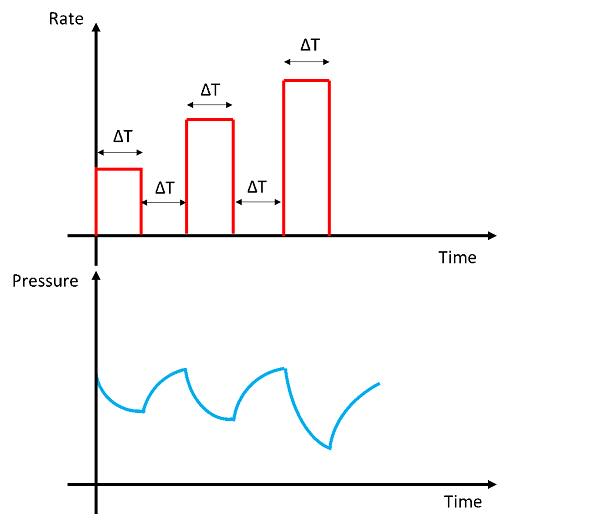
The flow period duration ∆T needs to be long enough to at least reach radial flow regime so that the rate data at surface are representative of the reservoir and not dominated by wellbore storage effects. An earlier PBU analysis will help to improve the design of the deliverability test.
Not only this test requires a lot of logistics, but it will end up with a relationship between pressure and rate (IPR) which is independent of time. However, wells in low to mid permeability reservoirs are dominated by transient behaviour, i.e. by a relationship between pressure and rate WITH TIME. So complex deliverability tests won’t be too useful for these types of reservoirs.
Misleading well and reservoir performance
With transient behaviour (dominant in low to mid permeability reservoirs), you risk obtaining a wrong inflow performance relationship (IPR).
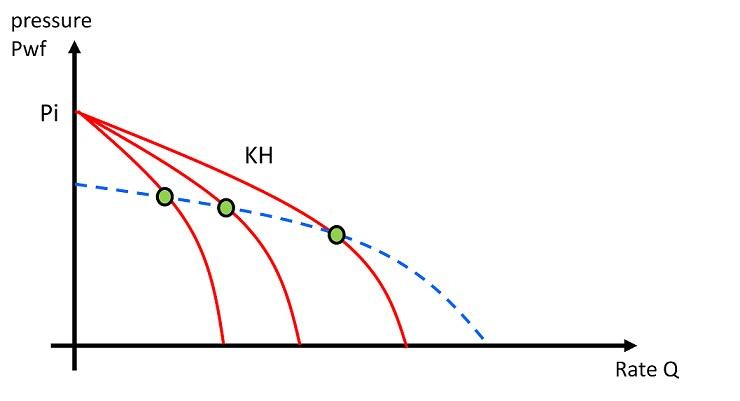
A transient IPR will change over time, as indicated with the different plots in red. Under transient behaviour, the risk is to assume that the several flowing points are under pseudo-steady state and on the same stabilized IPR. This will lead into erroneous reservoir pressure, KH and skin.
As a matter of fact, the skin can only be derived from a PBU analysis.
Reservoir performance from PBU analysis
Some few flowing pressure points and rate data do not define the productivity of a well, especially under transient behaviour. It will be misleading and will result in wrong KH, skin, reservoir pressure, and hydrocarbon volume.
The well and reservoir performance should be derived from well test analysis on several PBUs.
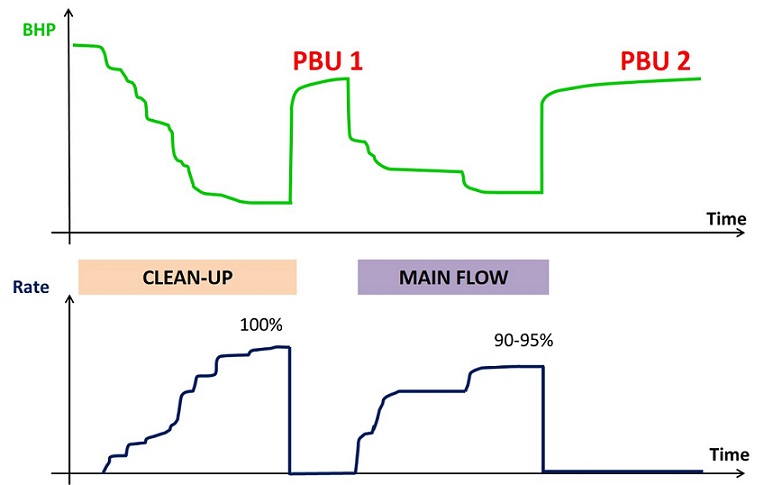
Everything can be obtained from 2 PBU tests: permeability and skin, the different skin elements, initial pressure, heterogeneities, hydrocarbon volume, distances to the boundaries, etc… All this information can then be used to build the IPR, for example.
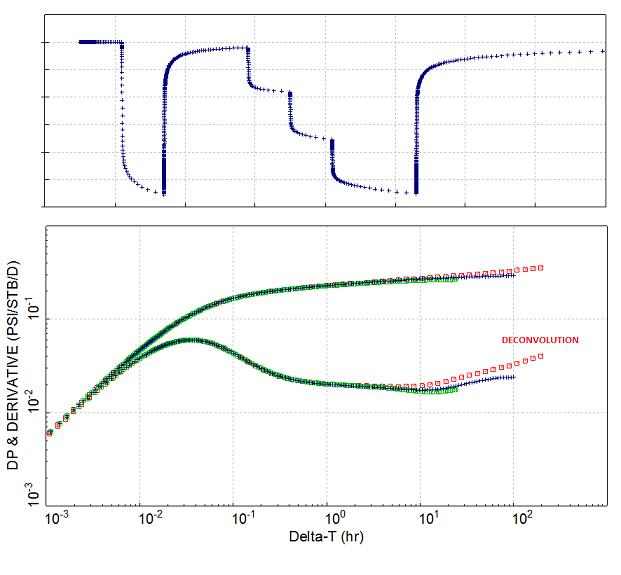
In a well test design study, you should forget about adding a complex deliverability test but focus on two PBU tests and make sure the shut-ins are long enough to derive a reliable deconvolution.
Short step rate test to obtain the non-darcy skin
More (reliable) information is extracted from PBU analysis than from any deliverability test. The only test that you should be interested in is a simple increasing step rate test for gas and gas condensate wells.
This is different from the flow-after-flow test because we don’t need to wait for pseudo-steady state. We only need to flow for a couple of hours and make sure that radial flow regime is at least reached for each step (and not dominated by wellbore storage effects).
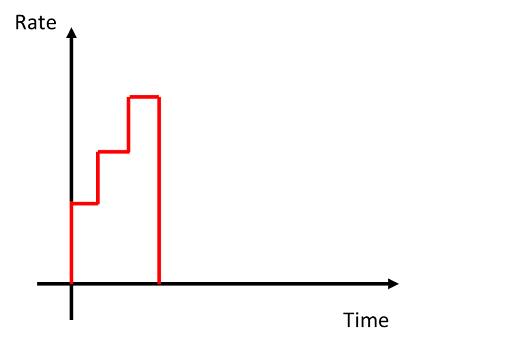
For dry gas and gas condensate wells, a short flow-after-flow test (3 increasing step rate tests) can be designed to evaluate the turbulence factor (non-darcy skin).
This test is not to define the inflow performance relationship (IPR), but to extract the turbulence (or non-darcy skin element). As a consequence, the criteria shouldn’t be to wait for pseudo-steady state and the test can be shortened to a couple of hours.
In the well test analysis workflow, we first need to match all the PBUs, as shown below.
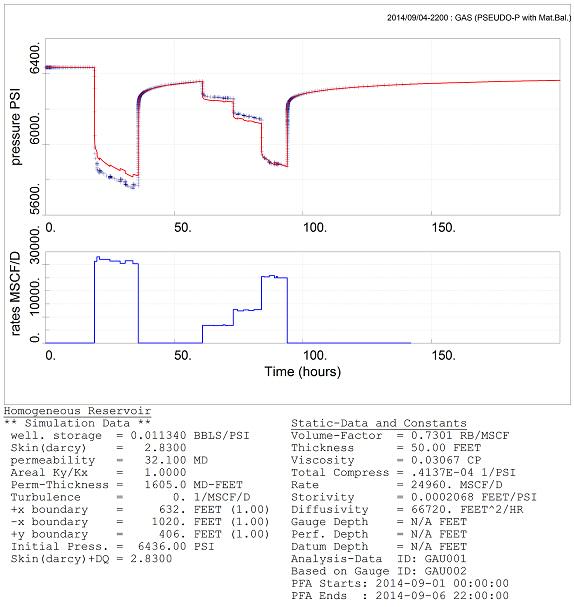
(It is worth noticing the “depletion” trend in the PBUs. This doesn’t mean that the reservoir is closed and reservoir pressure changes. In this case, it only supports the presence of boundaries).
Once all the PBUs are matched, the user can match the short step rate test by tweaking the non-darcy skin.
By increasing the turbulence factor while decreasing the mechanical skin to keep the total skin constant, we obtain a match on the deliverability test.
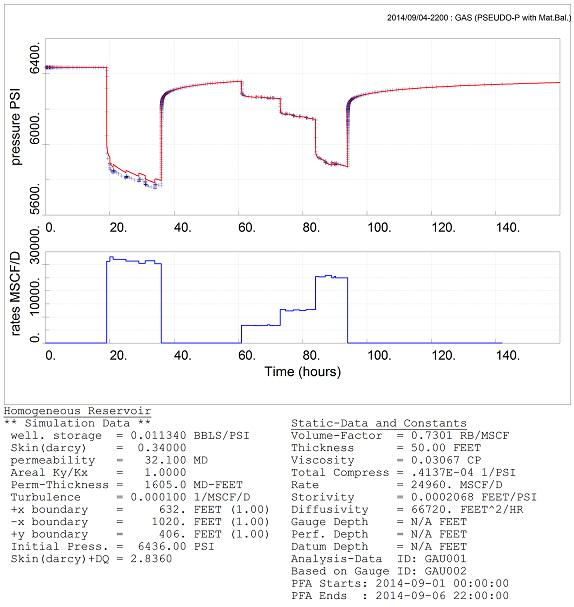
The first flow period from 20 to 40 hours cannot be matched and shows that the skin in our model is too low during that period. In reality, the actual skin was larger at the beginning of the test and the well is slightly cleaning up.
Some well test softwares, such as Saphir and PIE, offer an option to automatically calculate the non-darcy skin based on the short step rate test.
Step rate test can be dominated by wellbore dynamic effects and not be representative of the well and reservoir.
Several flow periods in the step rate test can be dominated by a changing fluid density below the gauge. We need to place the pressure gauge as close as possible to the perforations and be cautious when matching the test.
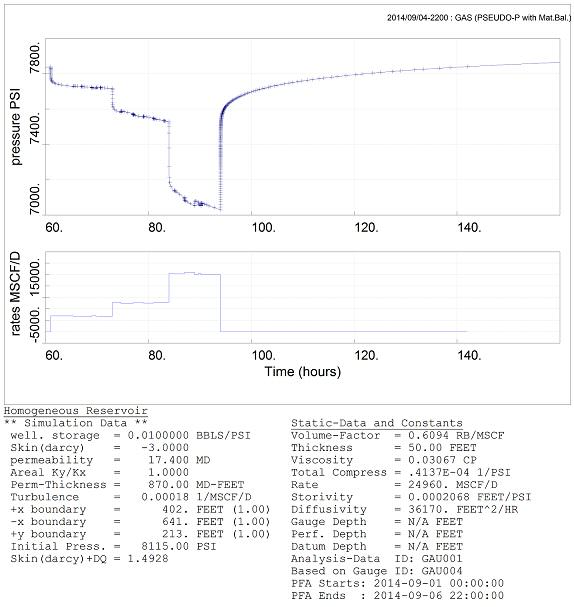
After a well test analysis, your model should match the several PBUs and the step rate test, as shown below.



Hi. Thanks for the post, very useful and informative.
With PBU we will get all the parameters required for IPR using either RS/Jones method or LIT method. But, here we need to assume drainage radius again, how to find that one using PBU?